
Rachel Harding
my very alive and visionary friend and poet

Rachel Harding, my dear friend, died on a trip with students to Brazil. She worked with priestesses as a participant in the candomblé religion there, brought over by folks from Africa who had been enslaved, and merged with Indigenous Brazilian practices. I have seen her every time I have been in Denver. I watched Kamala Harris debate Trump with her and others – we both liked Kamala and were furious with her unwillingness to speak out against the Israeli genocide. To stay in touch, she would write me short notes about my posts on Democratic Individuality she liked.
I had called her and just listening to her message, told her on the phone how good it was to hear her voice. But she did not call back. I had a premonition that something was wrong.
She wrote an amazing book Remnants. Remnants: A Memoir of Spirit, Activism, and Mothering about her mother, both of their voices in it. She also wrote a book
A Refuge in Thunder: Candomblé and Alternative Spaces ...
about the cultures blacks brought over from Africa with them (her mother had memories of ring dancing from growing up in Georgia). They link resilience, mysticism, generations of mothering, and are a motivation to this moment of activism as she tells startlingly for Ruby Sales, Harriet Tubman, and others in this dazzling talk at Brown.
Rachel was a poet who urged me to publish my collected poems and moved me to do it. . Most importantly, she was a person of great kindness.
She had had cancer several years ago and I hoped had beaten it. I heard a rumor of her death from Wally Barrett. Gloria Smith, her cousin and another dear friend, called me from Brazil to talk about death yesterday. There will be a memorial service at Iliff School on August 29th that I am writing something for and will go to.
Here are three beautiful poems from her substack Dawn Daydreams:
Ways to live a life
My late Uncle, perspective, and a poem
RACHEL HARDING
APR 30, 2025
Recently, I met my Aunt at a coffee shop. We discussed our lives and then world affairs, like we have any control over them. Political discussions often end up making me feel small. But we aren’t small, are we? Even still, I tried to talk about anything else because anything else is always happening: someone saw a film that changed their life; someone grew a whole inch; someone took up baking; someone lost a love; someone has a story to tell. We started to talk about my late Uncle, my Aunt’s husband. We smiled and laughed as we reminisced.
He was an elusive figure for all of my life, popping in like a cartoon character, and then gone as quickly as he came. I saw him mainly at birthdays and holidays, even though he lived 10 minutes from my childhood home. But he’d enter and quickly make his presence known. He’d share an off-color joke, we’d look away to giggle, or cringe, or both. Then he was off to the backyard for a Marlboro Red.
My Aunt, the sister of my father, married my Uncle in her twenties. I loved my Uncle because he loved me, but I liked him because he was himself, even when that self wasn’t always acceptable to our family. He’d say belittling comments to my Aunt; she’d laugh him off and say something equally harsh right back. It’s how they always were together, at least during the time I knew them.
He’d spoil me with food, making the best mashed potatoes I’d ever tasted. He had a trick: boil the potatoes with chopped onions, then mash it all together; what a savory flavor! He was an excellent cook, a great dresser, and always smelled nicely of a fresh shower and a heavy dose of cologne.
As a teenager, my boyfriend and I once visited him together; his round, wooden coffee table was covered in 100 dollar bills, so many of them. He looked at us, straight-faced and said, “do you need any money?” It was comical to me, then and now. I didn’t take any money that day, although I knew he meant it.
Thanks for reading Dawn Daydreams! Subscribe for free to receive new posts and support my work.
He was a cash man in a plastic world. The simple things were his favorite: the pleasure of a front porch sit with a cigarette and a beer; preparing steak and potatoes, with plenty of butter; and keeping his home clean and tidy. My Uncle liked to have a good time in this short life, and I think if I’d known him in his youth, I’d understand that even more!
His stories were embellished but always a good listen. To the dismay of my parents, he cursed around my brother and me, even while we were young children. Throughout my life, during family functions, you’d find him tucked away at the end of the table or in the corner of the room, entertaining my visiting boyfriend.
It’s quiet without him. He was big for how, supposedly, small we all are.
During our visit, I asked my Aunt about his childhood: adoptive parents that attended ivy league schools, taught at Stanford, and had four biological children. But she said he never liked those adoptive parents. I began to inquire about how he arrived in the United States in the first place. All stories I heard as a child, but through the years, I had forgotten.
My Uncle was born in Germany in 1943, when people were starving. At the age of two, he was found wandering the streets, by his soon-to-be adoptive father. At that time, his adoptive father was in Germany due to the war, and tried to send my Uncle back to his biological mother. She didn’t want him, either because she couldn’t feed him or simply didn’t care, but either way he went to a children’s camp instead. It wasn’t until he was seven years old, that the adoption was finalized, and he was sent to the United States. But during that time, people didn’t have enough and the children were hungry. Food was so scarce, that my Uncle and the other children fed themselves by digging up and eating raw potatoes, covered in dirt, straight from the ground.
If my Uncle hadn’t been adopted and brought to the United States, it’s likely he wouldn’t have survived overseas. And in this new land, he lived a life without want; with high-earning, educated parents; growing up in Palo Alto, California, just outside of San Francisco. Although it came with a cost, as he never felt equal to the other children, and he was treated more like a servant.
My Uncle escaped being an unwanted outsider in his new life by cooking and caring for the other children; I believe it’s where he developed his cooking skills, as he always valued delicious food and the time and preparation it took to make a meal great. For decades, before his death at the age of 78, my Aunt was spoiled with this gift.
I never knew my Uncle’s adoptive parents and cannot speak to their character, but I won’t forget the only time I met his father. My brother was 8-years-old, and I was 11. We flew from Florida to California with my Aunt, my Uncle, and our grandmother, whom we referred to as “Nana.” My Uncle’s father picked us up at the Santa Monica airport in one of those long, woody station wagons with big, clear windows. The tires looked like they were about to fall off, threads sticking out all over each one. My Uncle started making jokes about the tires, colorfully spoken and laced, as always, with curse words. My brother and I were chuckling, and I could hardly wait for our wagon adventure with this strange man. I stared at his father the whole way to the house. His gray nose hairs were at least an inch longer than his nostrils, his ear hair erupted out like several, long arms reaching; and I couldn’t believe it was even possible. It was my first experience with untamed, male hair.
From the car window, the coastline view to Palo Alto was stunning. Until that day, I had never visited the beautiful state of California, and it was lovely, with highways running along lush coastlines.
We arrived in Palo Alto, passing Stanford University along the way, and parked in front of a two story, Victorian style home. Of course, we needed sustenance after our journey. Maybe some peanut butter crackers would have sufficed! But inside the house, other unknown relatives appeared, setting dishes of melted butter and fresh, steamed artichokes on the coffee table. My Uncle demonstrated how to rip off an artichoke leaf, dip it in butter, and then scrape off the “meat” with our teeth. I can still taste it, like it was yesterday, and it was 30 years ago.
Sadly, my Uncle died in the summer of 2021, still in the shadow of Covid, so we never had a funeral. My parents, my brother, and I visited him not long before his death. We didn’t know what to say, although we said a few words, as we all awkwardly sat on his living room couch. Somehow, we knew it was coming. His health had been declining for several years and procedure after procedure had beat down his body and his quality of life; his spark started to dim. The joys of life were now frowned upon, doctors orders: no beer; no Marlboro Reds; no butter. But he still enjoyed them from time to time. My Aunt said he did it (life) his way, and I sense she feels peace knowing it’s true.
I share this story because sometimes everything feels meaningless. Life can be harsh from beginning, middle, to end: pushing me to believe we don’t matter, we aren’t remembered.
It’s quiet without him. He was big for how, supposedly, small we all are.
As I grow older, I’m jaded by the meanness I see around me, and equally fascinated by this human experience; how it has the tendency to push us into hard, unfeeling things— making us less alive or differently alive— than how we entered it. How do I remain as softly alive as I started out? And if I do get hard, can I choose to tumble like a rock until I’m smooth and less sharp again? Can I form into a wise baby, a kind nobody— while feeling it all no matter how much it hurts?
When I think of dying, I often think of the lyrics to one of my favorite Arcade Fire songs, Afterlife. Growing up in church, the word the afterlife meant heaven. But to think about the end and think of these two words joined together . . .
“Afterlife
Oh my God, what an awful word
After all the breath, and the dirt
And the fires are burnt”
Lately, it’s been spoken to me that timing is everything. When I hear people say it, I can’t help but think life is beyond coincidence. I can’t help but see how connected we all are, constantly benefitting and harming each other. I see my own large role in the timing of life, in the loss of friendships and the loss of loves. The thought makes me feel happy inside when it benefits me, but when it harms me, it gives the unexplainable an explanation—maybe the hurt caused was due to bad timing.
But I don’t actually walk around thinking about timing, but I do walk around thinking of perspective and my own mistakes needing repair. I think of the role I have as a human in trying to learn to do good, and I think that is the role I have chosen. It is the role I will fail at again and again. It’s just one way to live a life, while hoping for more moments of perfect timing!
Another Day
A lot went wrong today,
and still,
this place has much to give.
And still,
there’s never enough time.
How perplexing:
to feel in love with life;
to feel hopeful.
My books - begging to be read;
paintings to be imagined;
the porch- waiting for a visit;
people to meet and love;
beauty to witness.
A lot went wrong today,
and still,
I have much to give.
And still,
there’s never enough time.
How paradoxical:
to water the plants;
to feel peace in my soul.
Rachel Harding
The Glimmers
a life grounded in joy, midlife angst, & a soundtrack for May
RACHEL HARDING
MAY 12, 2026
They’re always there, the glimmers, as my friend likes to call them. The good in every situation, diagnosis, moment. The hope asking to be seen and felt.
This good friend of mine has cancer, the all too familiar human journey that disrupts a life with medications, surgeries, regular doctor visits, and constant uncertainty. But the disruption that I didn’t expect was the joy, their ability to find the light in every moment. They have always been full of life and positivity. Now they’re doing life the same, but I’m paying more attention. The lesson they’re teaching me every day is to live ready to die, to suck everything out of life, out of love. Don’t leave anything on the table. Do it all; feel it all.
Watching someone I love do the opposite of sulking wakes me up to the urgency for living. It’s everything now, and it always has been. To mindfully live as human visitors to earth: the trip of a lifetime! What must I see? Who must I love? What flavors and sounds must be experienced? Pain, heartache, sadness, and death: all certain. Laughter, love, joy, and hope: as certain as the golden hour on the Gulf. They’re waiting to be seen, waiting to be found.
I didn’t expect to feel more alive after visiting someone I love with cancer. How foolish to think self-pity deserves to be on top. It’s not news that life is short, but the good news is that bravery, authenticity, and joy in the face of this disappearing existence is the key to enlightenment. To let go of the striving, the pretending, the hiding, and to be at peace in life, no matter what it brings.
There’s much we can compare and feel jealousy over, and in my mid-life, I look at a no bullshit life, lived authentically, full of love and joy, and I know that’s it. That’s not easy. That’s worth wanting. Everything else is fleeting, left here, but an open heart looking out to the unknown with bravery and desire; I covet that heart.
(Screaming into the void) I don’t want your car or your face or your life, just give me your fucking outlook!
And I know the truth, it takes years of work and a daily practice. When not much else distracting us here is worth our time, it’s worth the effort. To live and die well; I hope I am, I hope I will.
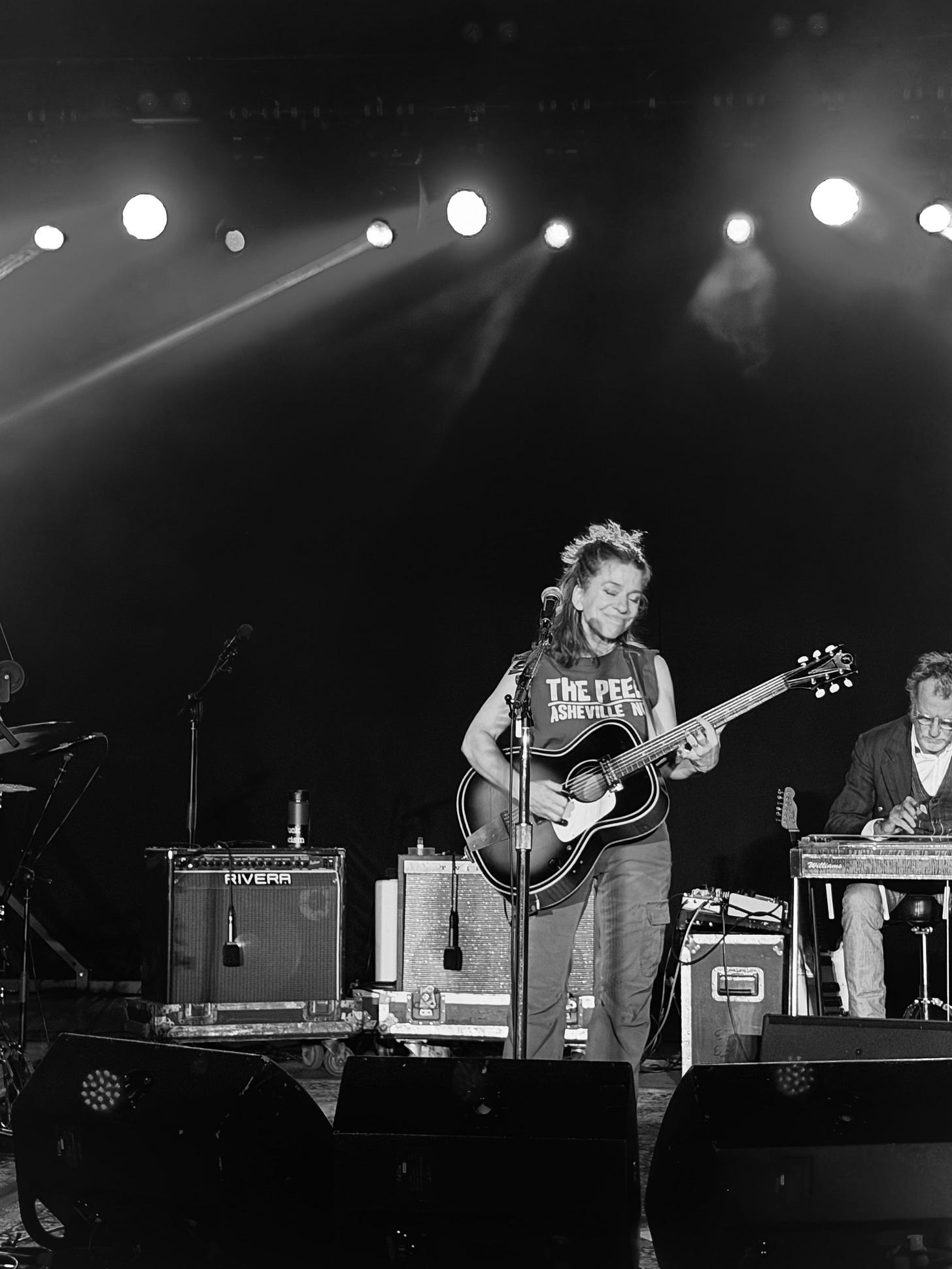
Ani DiFranco show during the visit with this same good friend
“Do or Die” hit hard that night, as Ani sang,
Do you ever just wanna give up
Well, me too
Are you shocked by what people get
Get used to
Do you wake up in a cold sweat?
Well, that’s sane
Least you got a little brain left
You’ve got a little brain
This same friend sent me an article recently that sent me down a rabbit hole of listening to the influential songs of my formative years. I racked my brain to find the ones that made me me. The ones I understood before I understood much of anything. I felt something real and intangible in 1997 while listening to “The Freshman” by The Verve Pipe. It played loudly on my boombox by the pool during my 7th grade birthday party.
For the life of me, I cannot remember
What made us think that we were wise and we’d never compromise
For the life of me, I cannot believe
We’d ever die for these sins, we were merely freshmen
Now at 42, my husband knows when I listen to Tori Amos, I’m going someplace alone. It’s the late 90’s, and I have no idea who I am, but I’m trying to find out if I can be rebellious and a Christian. Looking back, it wasn’t rebellion, it was a kid in the dark feeling everything and working to make sense of the world. Every song from that time built a map, and when Tori Amos sang “Northern Lad,”
And if you could see me now
Said, if you could see me now
Girls, you’ve got to know when it’s time to turn the page
and “Crucify,”
Why do we crucify ourselves every day?
I crucify myself, nothing I do is good enough for you
I crucify myself every day
I crucify myself
And my heart is sick of being
I said my heart is sick of being in
Chains, oh oh oh
&
Got enough guilt to start my own religion
I understood it somewhere deep in me, but I didn’t know why yet. At 15, you’ve lived enough to understand more than most adults give you credit for; I knew my heart would break and break again long before it did. I felt the longing for love, for freedom, long before I cleaned a toilet or drove a car. Then came my first breakup in 9th grade, Tori Amos’ “Jackie’s Strength” played on repeat.
Make me laugh, say you know what you want
You said we were the real thing
So I show you some more and I learn
What black magic can do
Make me laugh, say you know you can turn
Me into the real thing
So I show you some more and I learn
As a kid, grown ups appeared as these evolved, nice and tidy, figured out versions of themselves, because most grown ups were and are, nice and tidy. But growing up only makes us better at pretending. The honesty of a teen, of a child, gets left behind and sold for something more appropriate.
To think the highly emotional, angst would go away. It didn’t leave; it hibernated and returned in mid-life with the desire to rage against the machine and find the joy in everything at the same time. The desire to squeeze everything out, stare at it, dissect it, make sense of it, is ripe in adolescence, and it’s ripe now in mid-life. It’s a beautiful time of becoming again and shedding the grown up nonsense.
In the spirit of music making us who we are, journeying with us, reminding us of something or someone lost, here’s a playlist. I actually made it in May of 2025 and listened again recently only to realize this still tracks for May 2026, with the addition of a couple songs.
Happy May Days. Happy life, even when it sucks.
Happy listening,
Rachel
Tidal: May Days
OR
Spotify: May Days
Mushroom Houses, Snow, and a Poem
to end this January of 2025
RACHEL HARDING
JAN 30, 2025
Hello friends,
I made some time for drawing and painting this month, even though I was in a sickness fog for a bit. January forced me to slow down and be. Here’s a couple of my pen and ink watercolors, created while hermitting indoors.
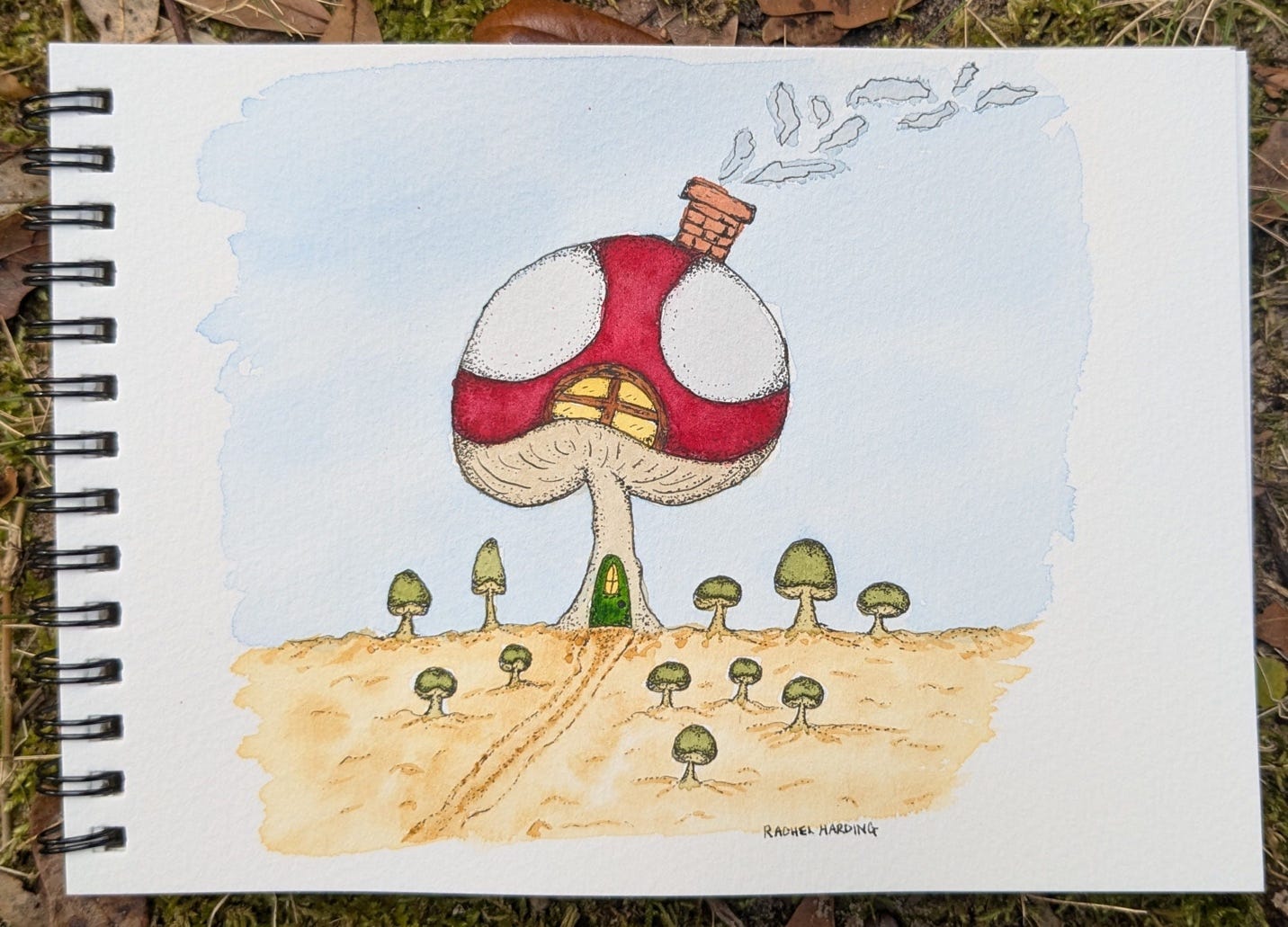
I imagine mushroom houses are tucked away in every yard.
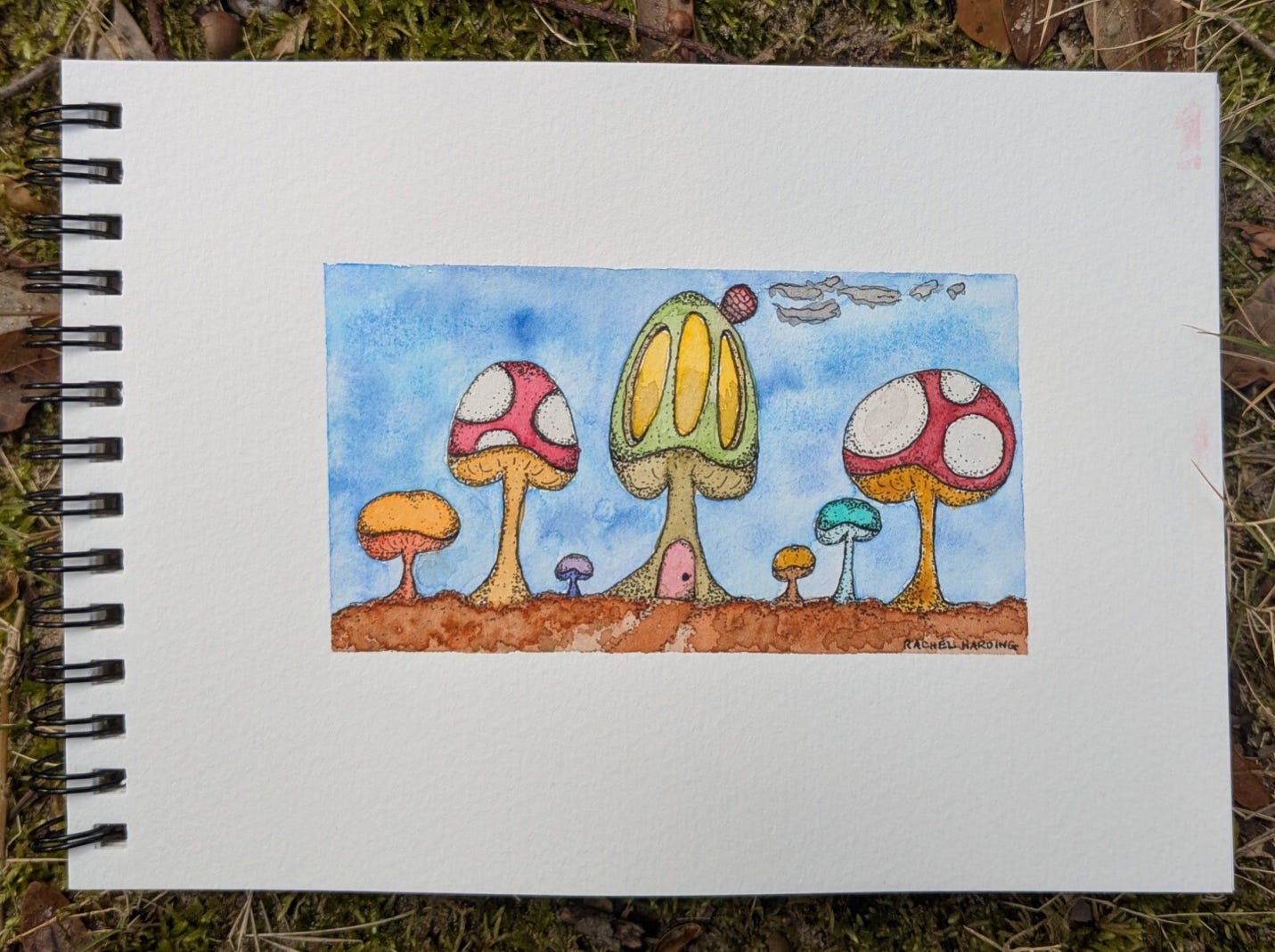
Little creatures mulling about in each one.
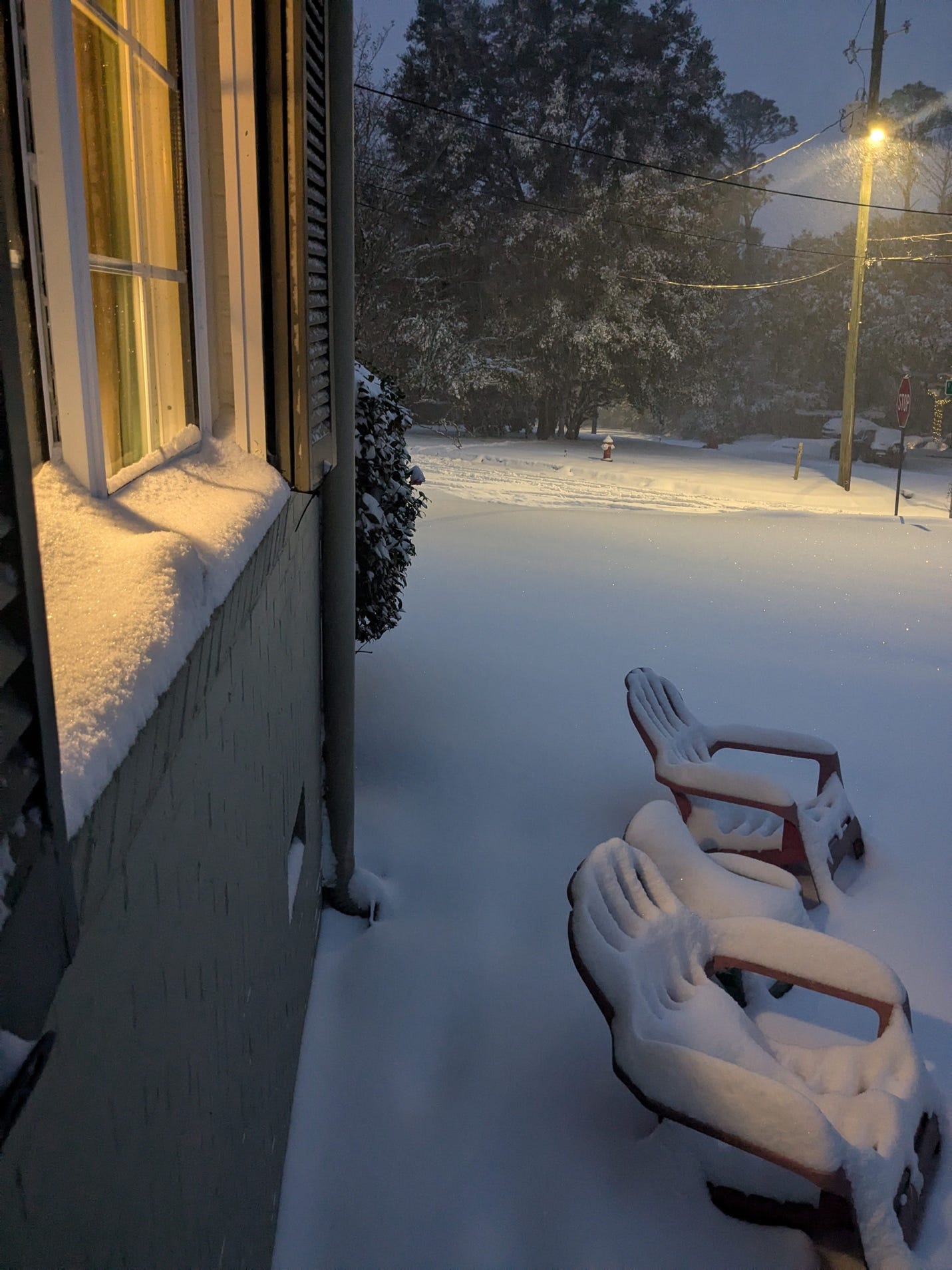
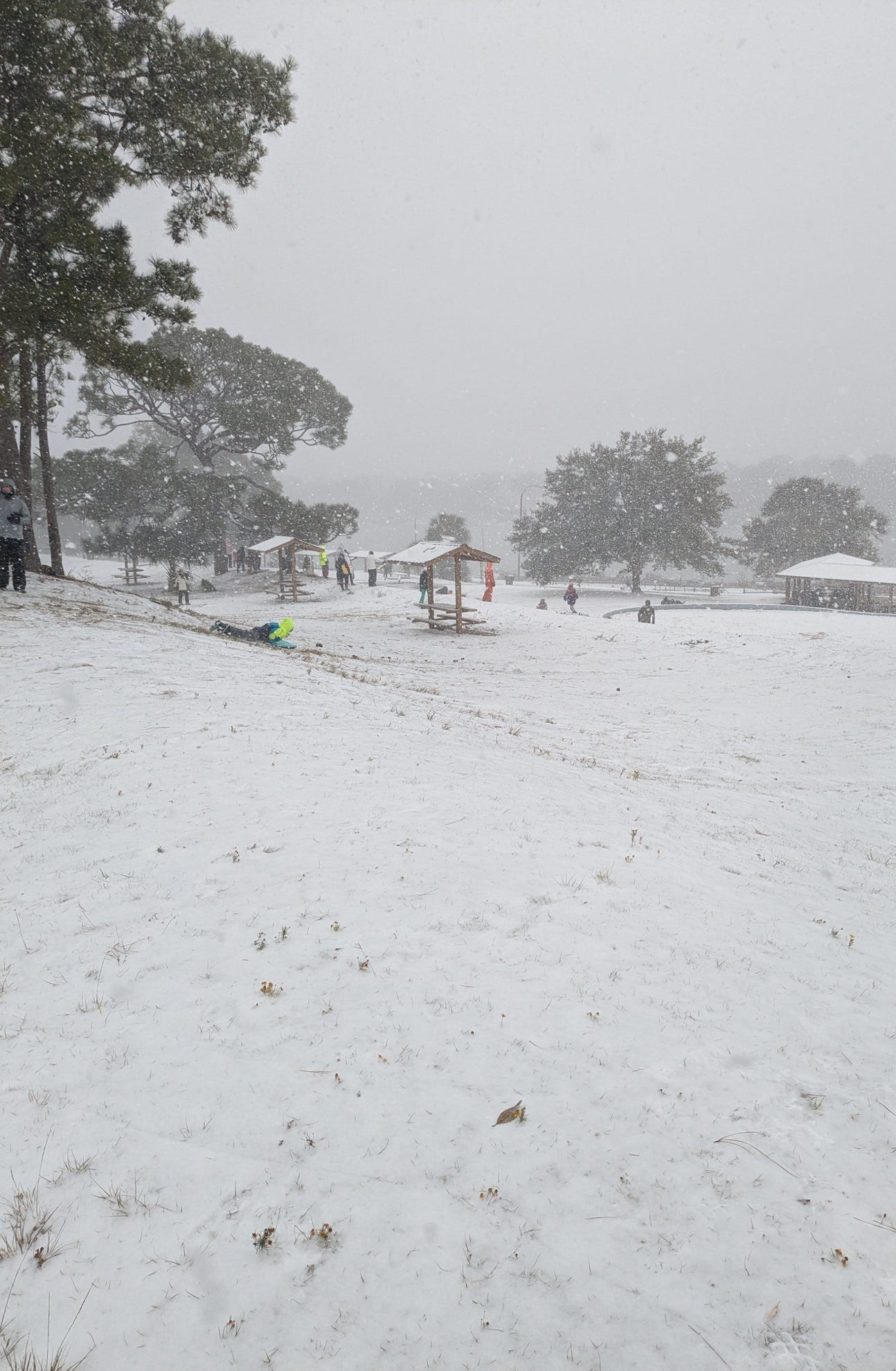
In the spirit of magic, it snowed 9ish inches in Florida last week. It was wild. We played like children. Life slowed, reminiscent of Covid, and neighbors emerged different, yearning to connect. I must admit, the time after a hurricane (assuming it’s not too damaging), is a special time and much like the snow days we had here in Florida.
Weather events are time stoppers, and when they aren’t life-threatening, they remind me of a world we could be: a slower world, a kinder world. Maybe it’s just me, but I quite like life when it’s quiet and unhurried. I found those coveted moments in the Florida snowstorm of 2025.
The park was full of sledders, snowboarders, and even surfboarders.
Our typically, mild winter town was blanketed in white powder.
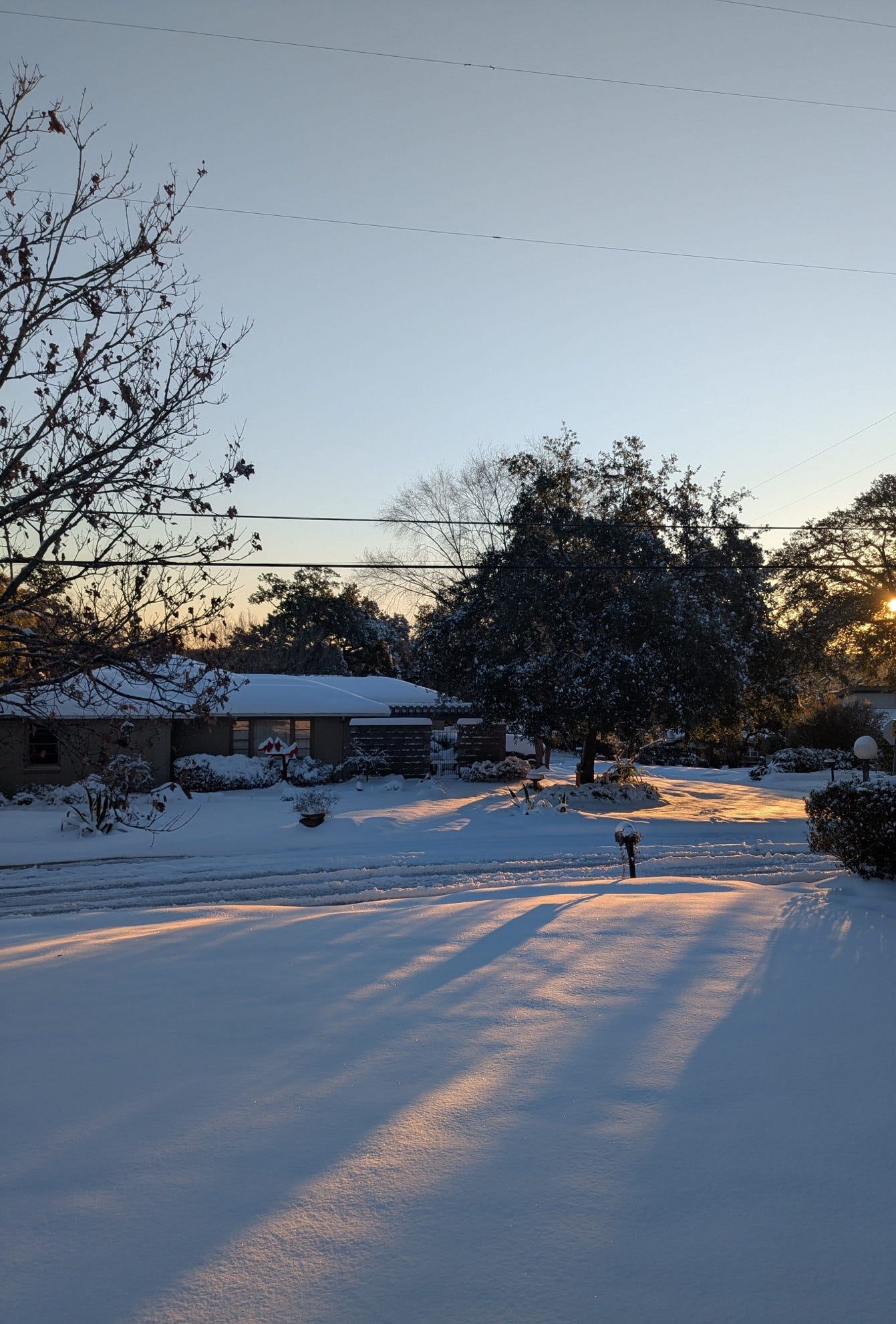
And then it melted. Life restarted as it was before the snow visited us, sunny and instantly warm as Spring.
I’ll leave you with a poem I wrote, recorded and written below.
A Hand
There’s no trick to living
with the lights out.
There’s stumbling
and bumping,
reaching
for what’s solid:
a hand;
a book;
a paintbrush.
If only
I could reach the moon,
keep her full,
to remind us all:
life doesn’t stop
when it’s dark.
Rachel Harding
From a pbs interview along with her father, 2003, https://www.pbs.org/wnet/religionandethics/2003/01/17/january-17-2003-dr-vincent-harding-dr-rachel-harding-extended-interviews/23208/
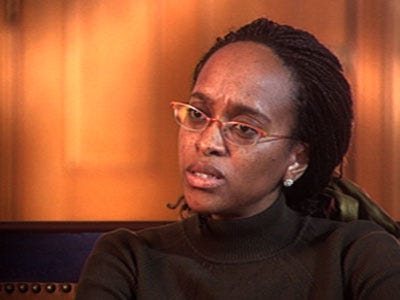
On art and religion:
Dr. Rachel Harding: The impulse to art, the impulse to creativity is very similar to the impulse to spirituality and to imagining and creating a more humane society. I think at root, the more exalted artists in our global societies as well as folk artists are looking for ways to express the deepest parts of their own humanity, and the deepest connections that they’re able to manifest, whether in song or in visual art or in dance, with something higher — a kind of collective meaning of who it is they are and how it is they’re connected to something beyond themselves. And religion, I think, at its base is that as well, an attempt to try to find something outside of our own individual identity that connects us to something larger, that stretches out beyond where we are and that is a part of what we come from… I think of artists in the African-American tradition such as John Biggers, Jacob Lawrence, and Elizabeth Catlett who represent the constant focus on the deep humanity, the deep dignity of their people who have struggled and been through so much trauma and hardship. But at the same time [they use that] as a foundation to stretch out and stretch up and connect with the humanity that all people share. Religion at its best does that too; it comes out of a particular and a specific experience, but it moves us toward a connection with others — the spirit.
Dr. Rachel Harding: What excites me most is as I look around the country, I’m aware of lots of people, particularly in the arts, who are finding different ways of interpreting and passing on the meaning of this story. I’m thinking for example of Cleo Parker Robinson, a local choreographer and dancer here [in Denver], and Ronald Kay Brown, who’s this wonderful African-American choreographer doing tremendous things to link up history and movement and spirituality in the dances that he creates, and a whole generation of word artists, poets, and performance artists who are building on the tradition of the black arts movement, the Chicano arts movement, the women’s coffeehouse poet movements from the ’60s and the ’70s, who are carrying on this tradition of passing on the story.
I am thrilled when I travel to different parts of the country and see the kind of energy and impetus that the movement that my parents and people of their generation were a part of has continued to ignite in folks my age and even younger. It’s very exciting, and you see it across the arts — in dance, in writing, in visual arts, in the music. This has something to do with the fact that human beings are always looking for ways to express our deepest humanity and our deepest connection to others. The movement for African-American rights and the expansion of democracy, as my dad likes to call it, was quintessentially that kind of thing, so there are a lot of people all around the country and other parts of the world who draw inspiration from it.
On poetry:
Dr. Rachel Harding: For me, poetry has been a way to make those spiritual and ancestral connections that become sources of sustenance in my life. Poets I admire and consider my mentors, such as Sonia Sanchez, Lucille Clifton, and Nathaniel Mackie, would describe the meaning of the work in similar terms. It’s a way to connect to something that gives you deep roots. And with the roots, then, you’re able to stretch out and move in directions that perhaps you wouldn’t have had the strength or the inspiration to do otherwise.